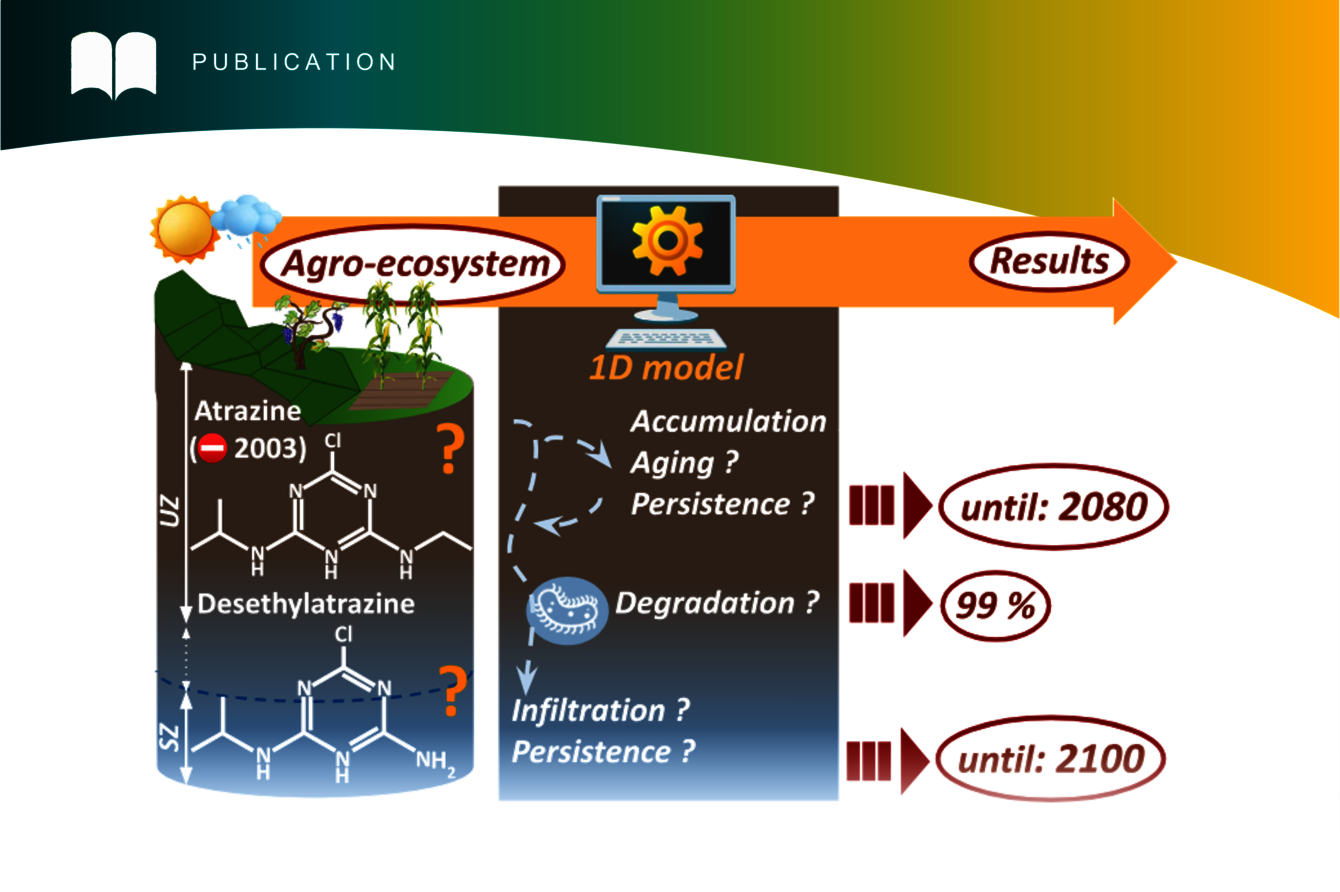


Comment expliquer la persistance de pesticides dans les eaux souterraines, des décennies après leur interdiction ? Une étude menée par Gabrielle Chedin et ses collègues mobilise la modélisation des transferts réactifs pour comprendre le devenir de l’atrazine et de son principal produit de transformation dans les sols agricoles. Appliquée à sept aires d’alimentation de captages de la nappe d’Alsace, cette approche montre que la zone non saturée des sols constitue un réservoir de contaminants dont la remobilisation peut prolonger la pollution des eaux souterraines pendant plusieurs décennies.
Ces travaux font écho aux enjeux explorés au sein de l’ITI SWITCH, notamment dans le cadre du Living Lab Aquifer, autour des interactions entre pratiques agricoles, fonctionnement des sols et qualité des eaux souterraines. Ils contribuent à mieux comprendre les mécanismes de transfert et de persistance des contaminants, afin d'améliorer l'évaluation des risques à long terme pour les ressources en eau.
Abstract
Understanding the long-term fate of legacy herbicides stored in the unsaturated zone is critical for predicting delayed groundwater contamination. This study develops and applies a parsimonious one-dimensional reactive transport model to reconstruct the multi-decadal dynamics of the persistent herbicide atrazine and its major transformation product desethylatrazine in agricultural unsaturated zones. The model integrates compoundspecific properties, historical herbicide application records, daily hydroclimatic forcing, and depth-dependent reactivity, including sorption, aging and the remobilization of non-extractable herbicide residues. The framework was applied to seven wellhead protection areas (53 km2) of the Alsace aquifer (France) and evaluated against long-term pesticide monitoring in groundwater. Simulations indicate that approximately 99% of the applied atrazine mass was biodegraded within the unsaturated zone. However, more than 99% of the remaining mass of atrazine and desethylatrazine still persists as aged non-extractable residues. Despite the ban of atrazine in 2003, the gradual remobilization of residues sustains low but continuous leaching to groundwater. Model projections suggest that this delayed release maintains detectable contamination for approximately six decades after the ban, with complete depletion of the unsaturated zone residue pool expected around 2080. Desethylatrazine exhibits greater mobility and persistence than its parent compound, resulting in higher groundwater concentrations and representing the dominant long-term contamination signal (until 2100). These results show that the unsaturated zone acts not only as a reactive buffer but also as a long-term reservoir sustaining legacy pesticide contamination long after surface applications cease. Explicit representation of historical inputs, residue aging, and remobilization processes in models is therefore essential for reliable long-term groundwater risk assessment in aquifers connected to agroecosystems.
Référence
Chedin, Gabrielle, Gwenaël Imfeld, et Sylvain Payraudeau. « The Unsaturated Zone of Agroecosystems as a Delayed Source of Legacy Herbicides to Groundwater: A Long-Term Reactive Transport Modeling ». Journal of Contaminant Hydrology 282 (septembre 2026): 105047. https://doi.org/10.1016/j.jconhyd.2026.105047.