

Ces travaux s’inscrivent pleinement dans les enjeux de l’ITI SWITCH, à l’interface entre eau, agriculture et systèmes socio-environnementaux. Ils mobilisent la modélisation pour mieux comprendre les effets à long terme des pratiques agricoles sur la qualité des eaux souterraines et les mécanismes de persistance et de transfert des contaminants dans les agroécosystèmes.
L’étude porte sur plusieurs aires d’alimentation de captages de la nappe d’Alsace et contribue ainsi à une meilleure compréhension des interactions entre activités agricoles, fonctionnement des sols et ressources en eau, en lien avec les enjeux de durabilité des territoires.
Abstract
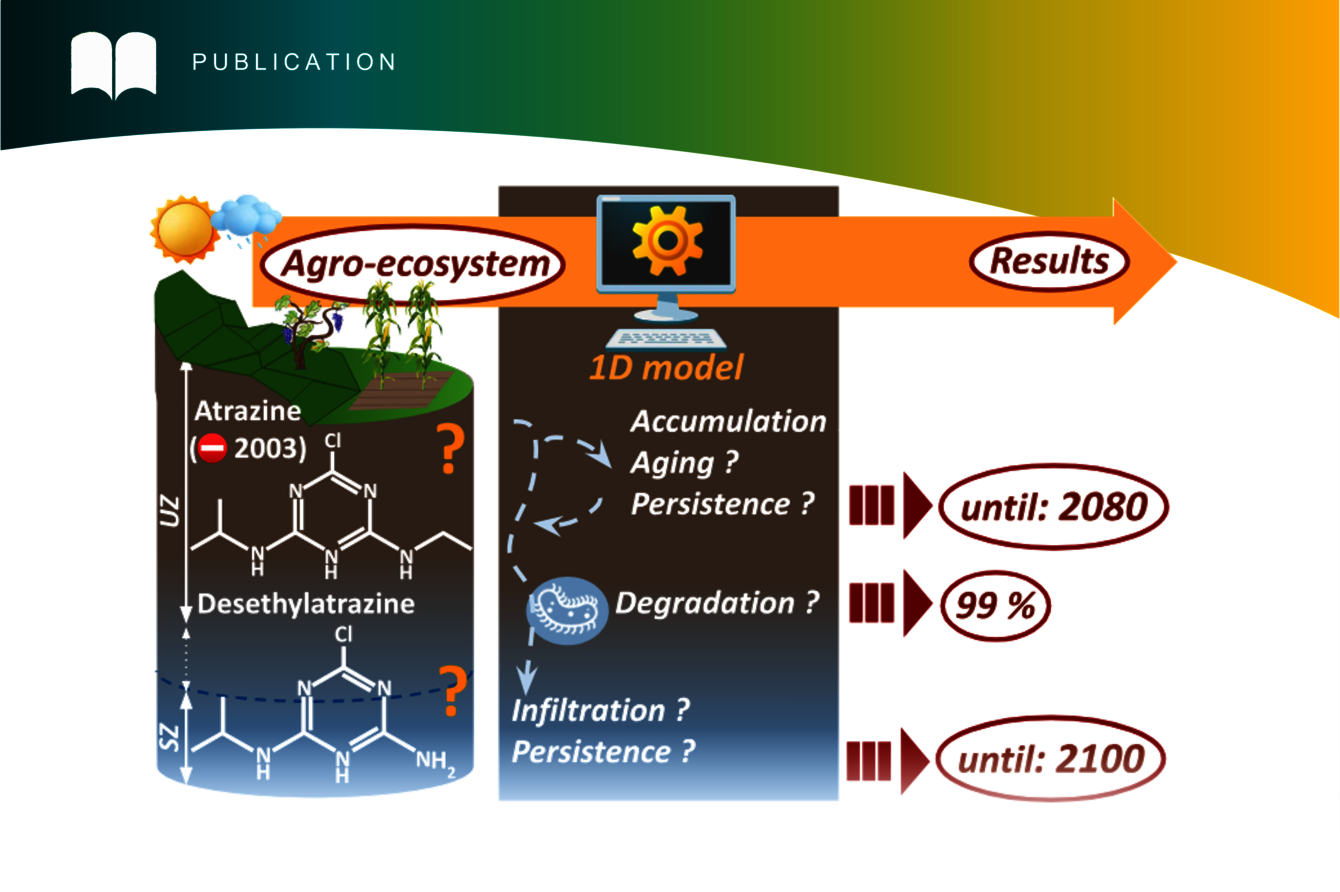
Understanding the long-term fate of legacy herbicides stored in the unsaturated zone is critical for predicting delayed groundwater contamination. This study develops and applies a parsimonious one-dimensional reactive transport model to reconstruct the multi-decadal dynamics of the persistent herbicide atrazine and its major transformation product desethylatrazine in agricultural unsaturated zones. The model integrates compoundspecific properties, historical herbicide application records, daily hydroclimatic forcing, and depth-dependent reactivity, including sorption, aging and the remobilization of non-extractable herbicide residues. The framework was applied to seven wellhead protection areas (53 km2) of the Alsace aquifer (France) and evaluated against long-term pesticide monitoring in groundwater. Simulations indicate that approximately 99% of the applied atrazine mass was biodegraded within the unsaturated zone. However, more than 99% of the remaining mass of atrazine and desethylatrazine still persists as aged non-extractable residues. Despite the ban of atrazine in 2003, the gradual remobilization of residues sustains low but continuous leaching to groundwater. Model projections suggest that this delayed release maintains detectable contamination for approximately six decades after the ban, with complete depletion of the unsaturated zone residue pool expected around 2080. Desethylatrazine exhibits greater mobility and persistence than its parent compound, resulting in higher groundwater concentrations and representing the dominant long-term contamination signal (until 2100). These results show that the unsaturated zone acts not only as a reactive buffer but also as a long-term reservoir sustaining legacy pesticide contamination long after surface applications cease. Explicit representation of historical inputs, residue aging, and remobilization processes in models is therefore essential for reliable long-term groundwater risk assessment in aquifers connected to agroecosystems.
Référence
Chedin, Gabrielle, Gwenaël Imfeld, et Sylvain Payraudeau. « The Unsaturated Zone of Agroecosystems as a Delayed Source of Legacy Herbicides to Groundwater: A Long-Term Reactive Transport Modeling ». Journal of Contaminant Hydrology 282 (septembre 2026): 105047. https://doi.org/10.1016/j.jconhyd.2026.105047.