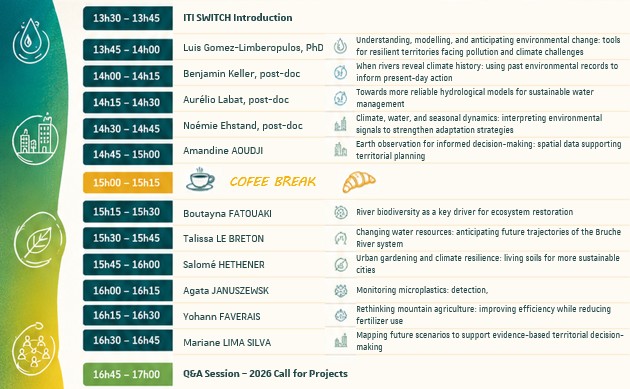
ITI Switch introduction | 13:30–13:45
PhD & Post-doc projects
FAMILAIR (Luis Gomez – PhD) | 13:45–14:00
Family Mobility and Air Pollution
Project supervisor: Nathalie Picard
Study of urban mobility and its impacts on air pollution through the analysis of household travel decisions and public policy effects. Development of econometric models and mobility–pollution simulations to produce scenarios and decision-support tools for the Eurometropolis of Strasbourg.
VOCBRUCHE (Benjamin Keller – Post-doc) | 14:00–14:15
Voyage au centre de la Bruche
Project supervisor: Gilles Rixhon
Analysis of river dynamics and sediment trajectories under human pressures. Investigation of interactions between river evolution and anthropogenic activities using interdisciplinary approaches and sediment characterization methods to support river management strategies.
TURNING (Aurélio Labat – Post-doc) | 14:15–14:30
StrucTUring and facilitation of Research communities on Nuclear power and decommissionING
Project supervisors: Dominique Badariotti, Fanny Greullet
Development of a scientific community focused on nuclear decommissioning and its socio-territorial impacts. Organization of interdisciplinary seminars and exchanges to identify key research priorities, stakeholders, and shared frameworks for addressing these emerging challenges.
ARClimS (Noémie Ehstand – Post-doc) | 14:30–14:45
Analysis of Regional Climate change Synthesis
Project supervisor: Marie-Claire Pierret
Analysis of climate change in the Alsace–Vosges region over the 1950–2024 period using climatic and hydrological data. Development of territorial climate indicators in collaboration with local stakeholders to support climate change adaptation and mitigation strategies.
Master thesis projects
ARClimS-2 (Amandine Aoudji) | 14:45–15:00
Analysis of Regional Climate Change Synthesis – 2
Project supervisor: Noémie Ehstand
Analysis of recent climate change (1950–2024) in the Alsace–Vosges region through the development of territorial and sector-specific climatic and hydrological indicators. These indicators are designed to match local stakeholders’ priorities and information needs, in order to support climate change mitigation and adaptation strategies.
Cofee Break | 15:00–15:15
RIPAF (Boutayna Fatouaki) | 15:15–15:30
Rivers in Protected Areas in France: Spatial and Governance Models for Sustainable Freshwater Landscapes
Project supervisor: Silvia Cardascia
Study of how rivers are represented within biodiversity conservation frameworks and of governance fragmentation in France. Assessment of inconsistencies between conservation instruments and their ability to integrate fluvial dynamics, using GIS and a multi-scale institutional approach in the context of European ecological restoration policies.
Alter-Bruche (Talissa Le Breton) | 15:30–15:45
Conception d’un alter-atlas pour une habitabilité désirable de la vallée de la Bruche
Project supervisors: Andreea Grigorovschi & Jean-Yves Georges
Exploration of future habitability conditions in the Bruche Valley under climate change and water resource pressures. Analysis of interactions between land use, landscapes, infrastructure, and water cycles through a bioregional and transdisciplinary approach, leading to the development of a prospective Alter-atlas of the territory.
JESPPAIR (Salomé Hethener) | 15:45–16:00
Jardiner sur sols pollués : quelles politiques, actions, interactions et représentations ?
Project supervisor: Sandrine Glatron
Study of urban gardening practices on potentially contaminated soils and of citizens’ and stakeholders’ representations. Analysis of knowledge, motivations, and barriers to urban agriculture, as well as their effects on behaviour and public decision-making.
PARTICIP (Agata Januszewska) | 16:00–16:15
Process Analysis of the uRban Transformations Induced by Citizen Participation
Project supervisor: Nadège Blond
Assessment of citizen participation mechanisms and their effects on the acceptability of sustainability transitions and on the reduction of resistance and polarisation. Analysis of perceptions, motivations, and impacts on local governance within the Eurometropolis of Strasbourg.
SOUWAT (Yohann Faverais) | 16:15–16:30
Effet de la matière organique du sol sur les régimes hydrologiques et le bilan hydrique sous différents scénarios agricoles : étude du bassin versant de la Souffel basée sur le modèle SWAT
Project supervisor: Sylvain Payraudeau
Development of a methodological framework to monitor the effects of regenerative hydrology at the agricultural catchment scale. Identification of existing practices and pilot sites, and design of baseline and trajectory-based evaluation frameworks linked to hydro-agronomic and socio-economic indicators.
HYDRIVE (Mariane Lima Silva) | 16:30–16:45
Hydrologie régénérative pour améliorer l'état des rivières, la nappe phréatique, les stocks de carbone et la biodiversité.
Project supervisor: Karl Matthias Wantzen
Development of indicators and decision-support tools for regenerative hydrology in foothill and mountain socio-hydrosystems. Review of existing measures, implementation conditions, and technical and social barriers.
Q&A Session - Call for Projects 2026 | 16:45–17:00